

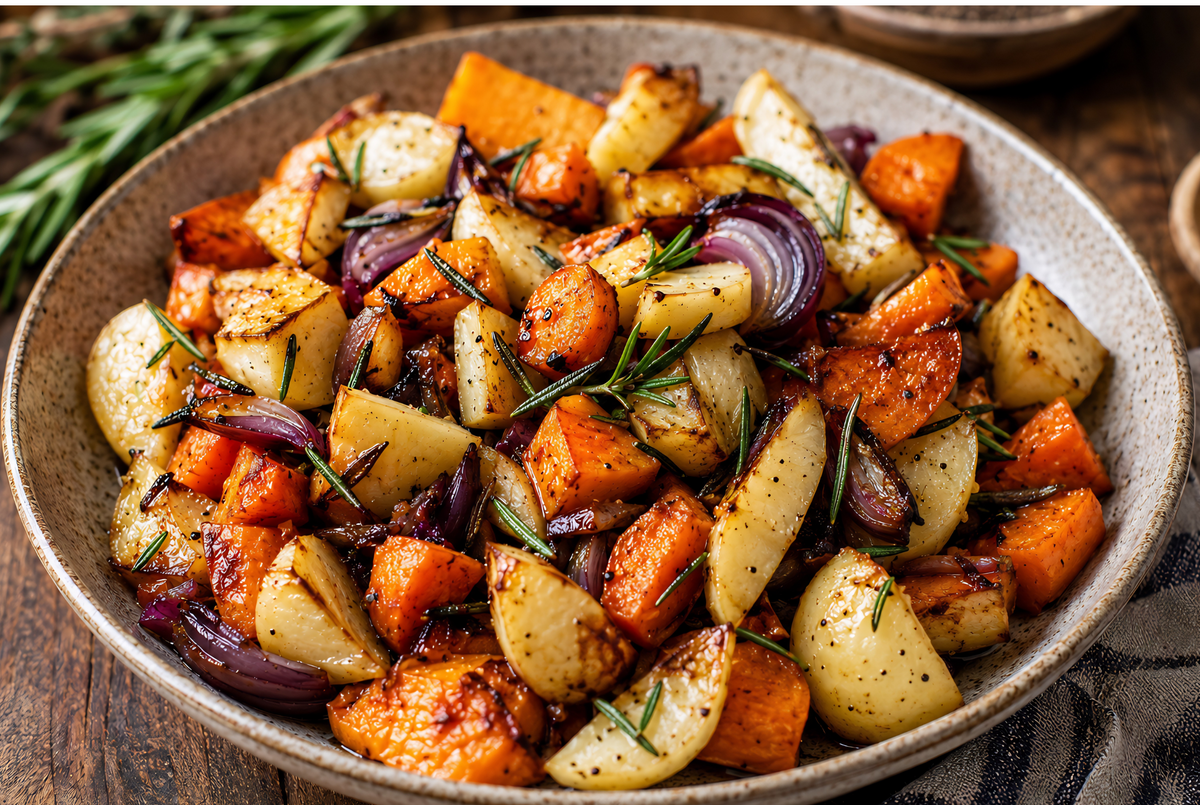
Rosemary Balsamic Roasted Root Vegetables
Rosemary Balsamic Roasted Root Vegetables
Description
Carrots, parsnips, sweet potatoes, turnips, and red onion are roasted with Rosemary Infused Olive Oil until tender and deeply caramelized, then glazed and finished with 25 Star Dark Balsamic for a savory-sweet seasonal side dish.
Recipe Overview
Servings: 6–8
Prep Time: 20 minutes
Cook Time: 40–45 minutes
Total Time: 1 hour to 1 hour 5 minutes
Ingredients
2 cups carrots, peeled and cut into 1-inch pieces
2 cups parsnips, peeled and cut into 1-inch pieces
2 cups sweet potatoes, peeled and cut into 1-inch pieces
1 cup turnips or rutabaga, peeled and cut into ¾- to 1-inch pieces
1 large red onion, cut through the root into thick wedges
¼ cup Rosemary Infused Olive Oil
3½ tablespoons 25 Star Dark Balsamic Vinegar, divided
1 tablespoon chopped fresh rosemary
1½ teaspoons kosher salt
½ teaspoon freshly ground black pepper
2 tablespoons chopped fresh flat-leaf parsley
Flaky sea salt, for finishing, optional
Instructions
• Preheat the oven to 425°F. Line two large rimmed sheet pans with parchment paper, or use one very large sheet pan if all of the vegetables can fit comfortably in a single uncrowded layer.
• Add the carrots, parsnips, sweet potatoes, and turnips or rutabaga to a large bowl. Drizzle with the Rosemary Infused Olive Oil and season with the fresh rosemary, kosher salt, and black pepper. Toss thoroughly until evenly coated.
• Divide the vegetables between the prepared pans in single, uncrowded layers. If using one pan, leave room for the red onion to be added later.
• Roast for 20 minutes without stirring so the vegetables have time to develop good contact browning.
• Meanwhile, keep the red onion wedges intact through the root and lightly brush or toss them with a little of the oil already coating the vegetables in the bowl, if any remains.
• Remove the pans from the oven. Add the red onion wedges, redistribute the vegetables if needed, and turn the root vegetables so another surface can brown.
• Return the pans to the oven and roast for another 15 minutes.
• Remove the pans from the oven. Drizzle 2½ tablespoons of the 25 Star Dark Balsamic evenly over the vegetables and gently toss to coat.
• Return to the oven and roast for a final 5–10 minutes, until the vegetables are tender when pierced with a small knife and deeply browned around the edges. Begin checking after 5 minutes; smaller pieces may finish sooner.
• Remove from the oven and, while the vegetables are still hot, drizzle with the remaining 1 tablespoon 25 Star Dark Balsamic. Toss gently, taste, and adjust salt if needed.
• Transfer to a serving platter and finish with the parsley, additional fresh rosemary if desired, and a light sprinkle of flaky sea salt. Serve warm.
Chef’s Tip
Cut the dense root vegetables as uniformly as possible so they become tender at roughly the same time. Give them plenty of pan space and let them roast undisturbed for the first 20 minutes to encourage browning rather than steaming. Add the red onion after that initial roast because it cooks more quickly, and wait until the vegetables are nearly tender before adding most of the balsamic so its natural sugars glaze the vegetables without spending the full roasting time in the oven. The final tablespoon added off heat restores a brighter balsamic finish.
Flavor Variations
• Garlic: Replace 1 tablespoon of the Rosemary Infused Olive Oil with 1 tablespoon Garlic Infused Olive Oil for additional savory depth while keeping rosemary as the primary infused-oil flavor.
• Fig: Replace the 25 Star Dark Balsamic with Fig Dark Balsamic for a deeper fruit-forward glaze that pairs especially well with pork, roast chicken, sausage, goat cheese, and blue cheese.
• Pomegranate: Replace the 25 Star Dark Balsamic with Pomegranate Dark Balsamic for a brighter fruit profile that works especially well with poultry, pork, lamb, and holiday meals.
• Black Truffle: Prepare the vegetables as written, then finish each serving with a very light drizzle of Black Truffle Extra Virgin Olive Oil. Use sparingly so the truffle complements rather than overwhelms the rosemary and balsamic.
• Beets: Replace up to 1 cup of the turnip, rutabaga, or sweet potato with peeled beets cut into ¾-inch pieces. Roast them from the beginning with the other dense vegetables. Be aware that red beets will color the other vegetables as they are tossed.
• Goat Cheese: Scatter crumbled goat cheese over the warm vegetables just before serving for creamy, tangy contrast.
Pairings
Serve alongside roast chicken, pork tenderloin, grilled steak, lamb, sausage, or salmon. Add a simple green salad, crusty bread, or hearty grains for a complete meal. These vegetables are especially well suited to Thanksgiving, Christmas, and other cool-weather dinners.
Build Your Plate
Turn these Rosemary Balsamic Roasted Root Vegetables into a complete seasonal dinner
The caramelized root vegetables, aromatic rosemary, and rich balsamic finish pair naturally with simply seasoned proteins and fresh or savory accompaniments.
Finished Side Dish
Rosemary Balsamic Roasted Root Vegetables with caramelized edges, fresh herbs, and a glossy 25 Star Dark Balsamic finish
Main Dish
Roast chicken, pork tenderloin, grilled steak, lamb, sausage, salmon, or another simply seasoned savory protein
Sides & Additions
Simple green salad, hearty grains, crusty bread, goat cheese, toasted nuts, or another fresh vegetable side
Flavor Pairing
Rosemary Infused Olive Oil provides the signature herbal character, 25 Star Dark Balsamic creates the savory-sweet glaze, and Fig, Pomegranate, Garlic, or Black Truffle offer distinct variations
Recipe Notes
Root vegetables vary in density, so uniform cutting matters more than making every piece exactly the same shape. Cut the carrots, parsnips, and sweet potatoes to roughly 1 inch, while slightly smaller ¾- to 1-inch pieces work well for firm turnips or rutabaga.
Large parsnips can develop a tough, woody core. If the center of a large parsnip looks especially fibrous, quarter it lengthwise and trim away the core before cutting it into pieces.
If your sheet pans are small, use two rather than crowding the vegetables onto one. Proper spacing allows moisture to evaporate and gives the vegetables room to brown. If using two pans, rotate their positions after the onion is added if one pan is browning noticeably faster than the other.
Refrigerate leftovers promptly in a covered container. Reheat in a hot oven or air fryer for the best texture.


